"Now to be clear, India has no such dish as a curry. No self-respecting Indian restaurant has a "curry" on their menu. They would have a Palak Paneer or a Malai Kofta or a Murgh Makhani - all of which we lump into "curry" - but no "curry"
- This is patently wrong. Curry is a South Indian word referring to vegetables originally (Malakkarry means vegetables). Come to Kerala - you have Moru Curry (Butter Milk Curry) , Erachi Curry (Beef Curry), Tharavu Curry (Duck Curry) etc. The author is a North Indian oblivious of curry history.
"കറി വെപ്പാനെന്തുള്ളത് കാട്ടിൽ,
വിറകിന് മാത്രം മുട്ടില്ലിവിടെ"
I understood exactly what you meant, no further clarification is needed. Take the parent comment with a grain of salt, it is clearly biased as Kerala might as well be a different country with its unique, southernmost coastal-climate inspired cuisine and dishes not seen in other parts of diverse India.
FWIW, I understood exactly what you meant on first reading.
Now to be clear, India has no such dish as a curry.
The wording "no such dish as a curry" is a little ambiguous here as to if you mean a single menu item called "curry" or items from the genre of curry. This might be were people are tripping up. However, you make yourself crystal clear with the following sentences:
No self-respecting Indian restaurant has a "curry" on their menu. They would have a Palak Paneer or a Malai Kofta or a Murgh Makhani - all of which we lump into "curry" - but no "curry".
If someone is saying you failed at making this point, I'm not sure they read the whole paragraph, or are just willfully ignoring the context and are looking for an argument.
I don't agree that this point is crystal clear. If they'd written "They would have a Palak Paneer, or a Moru Curry, or...." and at least included one dish with "curry" in the name, then there would've been no such confusion. But as it stands it sounds to me like it's claiming there is no actual Indian dish that contains the word "curry".
That etymology might actually be wrong. The kari for blackened, burnt, etc comes from കരി where the r sound is a dental flap type r sound, while the kari for curry comes from കറി where the r sound is the typical r sound. So it's more likely the etymology is from malakkarry, which means vegetables, meaning than kari from the blackened, burnt, etc meaning.
Perhaps, but the difference is pronunciation is not definitive evidence.
For example, curry veppu (curry tree) is pronounced with the regular r sound in the standard dialect, but in some dialects, it is instead kariyaappu with the dental flap r sound (the 't' in American English 'atom').
The kari for 'burnt', 'blackened' is also related to 'karuppu' for 'black', which is pronounced with the regular 'r' (like curry) instead of the dental one.
> Curry is a South Indian word referring to vegetables originally (Malakkarry means vegetables)
FWIW, Kannada has no such word. ಕರಿಬೇವು ("karibevu") refers specifically to the curry plant and (as far as I know) there is no word "kari" which refers to curries in general.
My parents had always told me that "curry" was, therefore, a generalization and anglicization of various dishes containing curry leaves. But seeing as "kari" is a word in several other South Indian languages, perhaps Kannada is just the odd one out.
I'm not much into food. I'm kinda the "I eat because I have to." My disclaimer is that I'm not an expert but here are a few interesting stories that might be relevant to this story.
I come from a place where there is a huge influence of the Japanese and grew up in folklores punctuated with Japanese stories. I got to know a tad more, when one of my school-friend took a keen interest in digging up British and Japanese soldiers remains from the World War, built a museum, and is regularly invited as a diplomat by both the Japanese and the British.
I grew up visiting many Japanese monuments, including the last stand of the INA's holding place in India where Subhas Chandra Bose worked with the Japanese.
For the food, from the story, I'm of the believe that the curry is more Bengal-ish than further mainland India. The food from my place are a major blend of our olden recipes spiced up with the Bengali recipe, with an additional dose of East Asia.
Also, most Indian Restaurants in India, if not owned, are pretty much run (cooks, etc.) by Nepalese. And most "Chinese" restaurants by Bengalis. Of course, the "Chinese" food in India are, well, very very Indian-ised.
I also grow up memorizing most scenes from "Bridge on the River Kwai" as that bridge, after crossing, goes through my home-stage to advance into India during the war.
> Also, most Indian Restaurants in India, if not owned, are pretty much run (cooks, etc.) by Nepalese. And most "Chinese" restaurants by Bengalis. Of course, the "Chinese" food in India are, well, very very Indian-ised.
A great many Indian restaurants in the US are also owned by Bengalis. I visited a Bangladeshi restaurant in Atlanta that was advertised as such. The owner mentioned that most of the Indian restaurants in the city were owned by Bengalis, so he decided to be open about it when he started his own.
For those like me who were confused by this paragraph as I was, Bengalis are a single ethnicity that is split between the countries of India and Bangladesh. Practically all Bangladeshis are Bengalis, and 80% of them are Muslim. Most Indian Bengalis are Hindu. A more complete explanation can be found here: https://www.differencebetween.com/difference-between-bengal-...
But looking this up still leaves me confused as to Rayiner's anecdote. Is he saying that many Indian restaurants in America are owned by Muslim Bangladeshis? Or just that the one you mention in Atlanta was? And is there a difference between Hindu Indian Bengali and Muslim Bangladeshi Bengali cuisine?
Bengalis on both sides of the Radcliffe Line speak the same language and share some aspects of culture. But there are still subgroups within them: https://en.wikipedia.org/wiki/Ghoti_people
From what I've been told, Ghotis and Bangals have distinct culinary styles.
Tongue in cheek: Each group claims their cooking is better but I can't say I care for either of them.
I used to live above a very conventional Indian restaurant in New York, and once in conversation the owner mentioned to me that he was from Bangladesh. I asked him if were any interesting special dishes from Bangladesh that we don't normally see on Indian restaurant menus in America, and he just shrugged and said something to the effect of "meh, it's all the same anyway." I thought that was kind of interesting. The food also wasn't particularly good, so maybe he just isn't really a food guy and came into owning the business somehow other than a passion for the culinary arts.
Had a friend who ran a restaurant in Palo Alto. He had been trained in a three Michelin star restaurant in Burgundy. When they opened they had rabbit, squab, and other great dishes, but hardly anyone would order them. Steak and salmon were the most commonly ordered. It wasn’t worth buying what is considered more “exotic” by the clientele — they just couldn’t sell enough.
Rabbit isn’t really exotic, I mean, maybe it is just in the USA? You can get rabbit at some Chinese restraints in Seattle, next to frogs and snails and such. I’m guessing there is some demand in the Chinese community for such meat, but it’s weird to hear rabbit considered exotic (like horse meat, both of which often end up in American dog food).
American cuisine is extremely pedestrian, and basically kid’s food. That includes the local adaptations of foreign cuisines (every country adapts foreign cuisine to local tastes, not picking on the US here).
I’m not really sure what American food is anymore. What does an American food restaurant have abroad anyways beyond McDonald’s. Maybe a soul food or texmex place in Beijing counts as such?
This kind of phenomenon is pretty common, basically due to network effects. Consider how many small town motels in the US are owned by Patels. Or those “Chinese” (definition and style changes in every country) restaurants: regardless of the cuisine written on the window (Sechuan, Hunan, Cantonese, Shanghaiese…) what is the ethnicity of the owner likely to be (depending on what country you live in)?
Cheaper, more diligent, less likely to cause issues.... Well at least these are some of the reasons I've been told.
Also Nepalese isn't necessarily Nepali citizens. India and Nepal are so intertwined, both countries citizens have free passage across each other. A significant percentage of Indian citizens in the very highly populated states of Uttar Pradesh, Bihar and Bengal are of Nepalese origin. I would assume the total number of Nepalese Indians would be at least 30-50 million, considering that the collective population of the above 3 states alone amounts to roughly 460 million.
A lot of chinese restaurants in the more south Bay Area are run by ethnic Chinese from Vietnam. They might go a bit into both cuisines to become a hybrid place that sells pho and Chinese food, actually I’ve seen places like that in Paris as well.
> I grew up visiting many Japanese monuments, including the last stand of the INA's holding place in India where Subhas Chandra Bose worked with the Japanese.
Rash Behari Bose (the subject of the article) and Subhas Chandra Bose were entirely different people from different generations.
I'm not that aware but reading Wikipedia on Subhas Chandra Bose[1], they have definitely fought and ideated together as part of the INA (Indian National Army). Here is a sentence from Wikipedia -- "In July (1943), at a meeting in Singapore, Rash Behari Bose handed over control of the organisation to Subhas Chandra Bose."
Indian when referring to the cuisine doesn't really refer to the political entity of modern India. Most of those restaurants serve a version of Punjabi food anyways.
Not sure. Maybe they tried both and Punjabi cuisine was more popular. Outside of Bengali enclaves, there are still comparatively few Bengali restaurants compared to Punjabi, Gujarati or South Indian.
> So if you are craving for spice in Japan, try one of the two thousand "Indian" restaurants and you will not be disappointed.
Erm, if you've had a proper curry recently then you probably will be. Like everywhere else, foreign foods get tailored to their locality or they die. If you fancy a naan filled with sugar and some pretty bland dishes then try an "Indian" restaurant in Japan. Which should come as no surprise, because plenty of other so-called spicy foods here are a) not spicy, and b) surprisingly/sadly, overly sweet.
That's not to say that you can't get a decent curry here, but you'll have to try harder than just walking into a random curry house. And this…
> Indian restaurants outnumber the top 3 pizza chains of the country put together!
I think the only food more maligned by localisation in Japan than pizza could be Mexican food, which leads us back to spice and sugar. I'm not sure what having more curry houses than pizza huts in Japan proves. It would mean something in the US or Italy, but in Japan?
Ha. Can confirm. Lived there 2 years and while I love the food, as far as I can tell there is no food available anywhere in Japan, at all, that the average south east asian would recognise as even mildly spicy. And outside the home islands I have observed Japanese people reacting hilariously to the actually spicy local food. My favourite was a co-worker who literally collapsed to the floor in the foetal position moaning after eating a mala hotpot which was, at best, medium heat.
Love the people, love the country, but Golden Curry's bright warning red "EXTRA HOT" is not bloody hot at all.
It took months to convince my family that the extra hot was mildy warm.
But also at a wagamamas in London I had them do double extra hot on their hottest dish and could barely tell. I'm American from the Midwest living in Seattle.
I refer to many spicy thing like that golden extra spicy as "spicy as katsup"
This is my problem with a lot of spiciness advertising around me (in America). When I order something advertised as "hot" or "very hot", 90% of the time it's either medium/mild at best, or just packed with spicy peppers to the point of just tasting bad.
But it can be hard to communicate to some people when their upper level of spice tolerance is banana peppers.
> This is my problem with a lot of spiciness advertising around me (in America).
It might just be a thing around here, but a lot of Indian or Thai restaurants have two separate heat scales, the 'normal' one, and the Indian or Thai one. One of the Thai restaurants that I used to frequent, for example, had a scale where 'spicy' was the same as 'Thai mild' and 'Thai spicy' would genuinely make your hair stand on end.
I don't blame them, and partially thank them. Far too many people are way too cavalier with ordering the spiciest dish and then blaming the restaurant for the dish not tasting good. Its also a lot easier to up the spice level on a dish than lower it. A curry that isn't spicy enough can be made spicier; A curry that is too spicy likely cannot be made milder.
I think the UK levels of spice are much lower than the US having been both places. Throw the pineapple chutney that I had at an Indian restaurant Bombay style in London plus summer was quite warm and delicious.
In my experience, "spicy ketchup" is almost never spicy, even in the least. What distinguishes it from other ketchups is that it's less sweet (but still very sweet). The only actually spicy ketchup I found is "Kotlin Extra Hot", but I'm not sure if it's a thing outside of Poland.
You mistake what I'm saying. Katsup is not spicy. I'm saying "you must think katsup is spicy"... it's more funny to people than saying "as spicy as water", "Man this catsup shore is spicy" just works better for a joke.
I'll have to try and find the Kotlin extra hot at the Eastern European grocery by my house.
Yeah I was gonna say this. Coco (and also smaller competing chain gogo) is Japanese curry that you can find in every city and can be ordered extremely spicy. And it’s not by default but any of the Indian curry places will make it very spicy if you ask. I’ve also gone out of my way to look up the most authentic places for a specific dish, and been able to order something so spicy I could barely finish it.
All of that being said, mild is definitely what to expect unless you ask for spicy or go out of your way for a specific dish.
Not by Thai or Sichuan standards it isn't. But to answer your question, denatured Korean food (esp. yakiniku BBQ) is widely available, and more authentic versions can be found if you head to the Koreatowns found in every major city (Okubo in Tokyo, Tsuruhashi in Osaka, etc).
In my experience, using scales of 1 through 10 (least to most spicy), a Japanese 10 is an Indian-in-USA 2.
I usually do a 5 to 8 on Japanese scale, though 3 or 4 is fine when eating with more sensitive people. 1 is tooo sweet, even when I was in grammar school, although it's marketed in Japan towards kids. If an Indian restaurant in USA offers only "mild, medium, spicy", I should choose mild because medium will cause about 30 hours of pain along the entirety of my digestive tract.
Having eaten at coco yichiban curry house a few times, a 5 is really really spicy, I typically stay at Normal or one pepper, since they charge for it anyways, no point to add on.
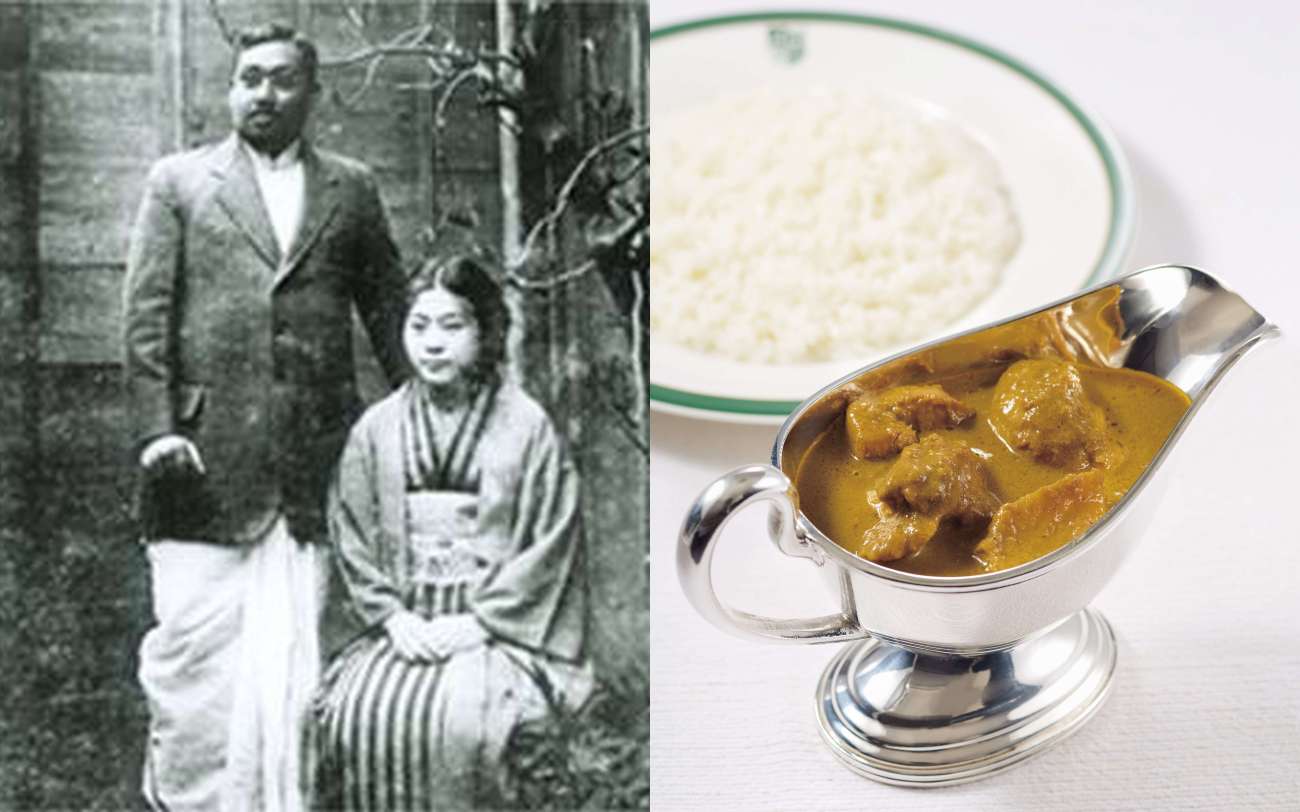
Bose’s original Nakamuraya original restaurant is still open and running, located in a passenger tunnel between shinjuku-sanchome and shinjuku station.
I found it a quite odd spot and configuration, considering the history.
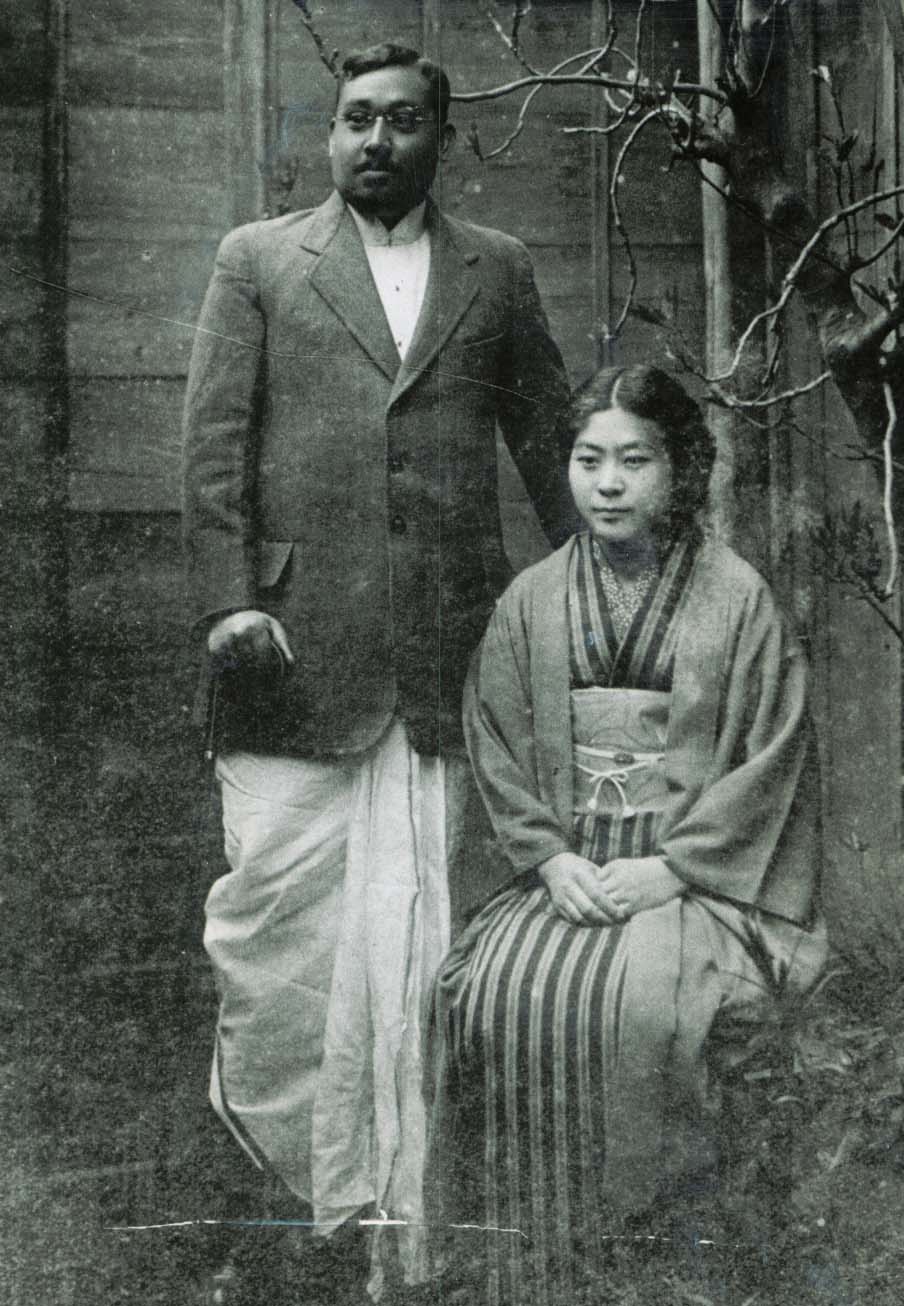
On a side note, I find it quite curious how the resolution on this image from WAttention [1] mismatches.
From the OP, the couple portrait attributed to Wikipedia, which is the latest 2018 retouched version [2], has a much higher resolution and specifies @Press as the source.
The 2016 original version [3] matches the couple portrait on @Press [4], which has the same blueish hue and the additional artifacts.
This links back to Nakamuraya's website itself [5], which has the same food photo combination as [1], but in consistent resolution.
At first, it seems to me that the couple portrait on [1] was (intentionally?) degraded because of the different lighting than [5], and the food photo is simply another version that was available during the retrieval (notice the crop). On second thought, it could have simply been another version that was available from Nakamuraya's. TIL images uploaded to Wikipedia are encouraged to be enhanced [6].
I wonder, as AI tools getting more pervasive, how many variations with artificial details will exist due to constant upscaling/downsizing? (Accurate replication might not be important in certain contexts, but I imagine artificial details will eventually leak into the chain of reference)
Of course, old photos like this are scanned/photographed into digital format in the first place.
Interestingly, the Nepali entrepreneurs also run a lot of restaurants here in Finland - along side Indian ones. Though I feel that there are more Nepalese ones. The cuisine is almost indistinguishable from North Indian cuisine, and I have heard from some folks who have visited Nepal, that authentic dishes from Nepal are missing from these restaurants. Though I suspect that might not entirely be true.
I moved from the UK, where Chicken tikka masala is famously the most popular food, and I am surprised that most of the Indian restaurants here are Nepalese.
Unfortunately the local Nepalese restaurants seem to have very very similar menus, and themed decor, along with a poor record of treating their workers fairly.
I do miss UK-styled curries, and Indian food, I think even though the foods have obviously been adjusted for the UK tastes there is a lot more variety available than in Finland. (Which I guess makes sense given the relative populations, and differences in terms of the number of Indian people who've integrated to both countries over recent decades.)
Interesting! I wonder how much of the indistinguishabilty is just them catering to their audience looking for North Indian recipes. There are definitely a lot of Nepali recipes that are very far from Indian cuisine.
It's almost all catering to local taste and what's expected. Nepali food is good but it's not as rich as what you'd get in a restaurant. Daal baht (rice with a thin lentil soup) is not what people expect if they pay $10-20. Hell, most northern indian restaurants feature foods that are way richer than you'd see in real home cooked cuisine. The restaurant versions invariably have way more heavy cream and butter than would ever be used in a typical home.
North Indian cuisine is more established globally because North Indians were either forced to seek economic opportunity abroad. It wasn’t then alone, but the numbers in many areas of the world make it clear off the early waves to the Middle East, Africa, England, canada, the us, and beyond.
Partition uprooted and scattered many families from the generally 1900’s Indian subcontinent across the world in waves.
Ahh, I absolutely love this. I frequently prepare this for dinner.
This is how you do it: https://youtu.be/QhsrBz9Cceg (nope, see edit.)
Fun thing is, my mom sort of makes this… she learned from my grandma. Almost the same recipe, except for the spring onion and other topings. When i saw this in a japanese cookbook and then the video from Kenji, i was totally amazed. Like if my grandma learned this from Kenji.
But we are as Dutch as Heineken. Where did my grandma got this recipe from… 50+ years ago? Probably some magazine and then an indian curry recipe from the uk? Who knows :-)
Edit: the image on top does look different from what I mean though. Interesting. Apparently there also is a different style of japanese curry.
The article/image are about Indian restaurants in Japan, which tend to have a large naan and a few small metal bowls of curry.
The one you're talking about is usually known as 'curry rice' (カレーライス) or 'Japanese curry' and has its roots in English beef stew, but with spice powder added. It is eaten over regular sticky white rice, often with a pork or chicken cutlet on top. I personally love it.
Co Co Curry in Japan is my favorite of the second kind. It's easy to come close at home, as dole says, but the restaurant lets you pick the exact spice level, and they always get the rice just right: sticky enough to carve out with a spoon, but still porous enough that it absorbs the curry sauce.
Go Go Curry is also worth a visit, and their US franchises are reasonably authentic. But it's a slightly different style: darker sauce that's more tangy than umami.
Go Go Curry is Kanazawa-style (thick almost like gravy, served over the rice with cabbage, on a metal bowl). It's very popular and lots of places do that style. If you like it I also recommend Champion Curry and Joto Curry.
I agree the rice is quite important. I've tried making it at home with basmati rice and it's not the same.
Co Co is great in how much you can customize it. I always go for very spicy curry with potatoes and fried chicken on top.
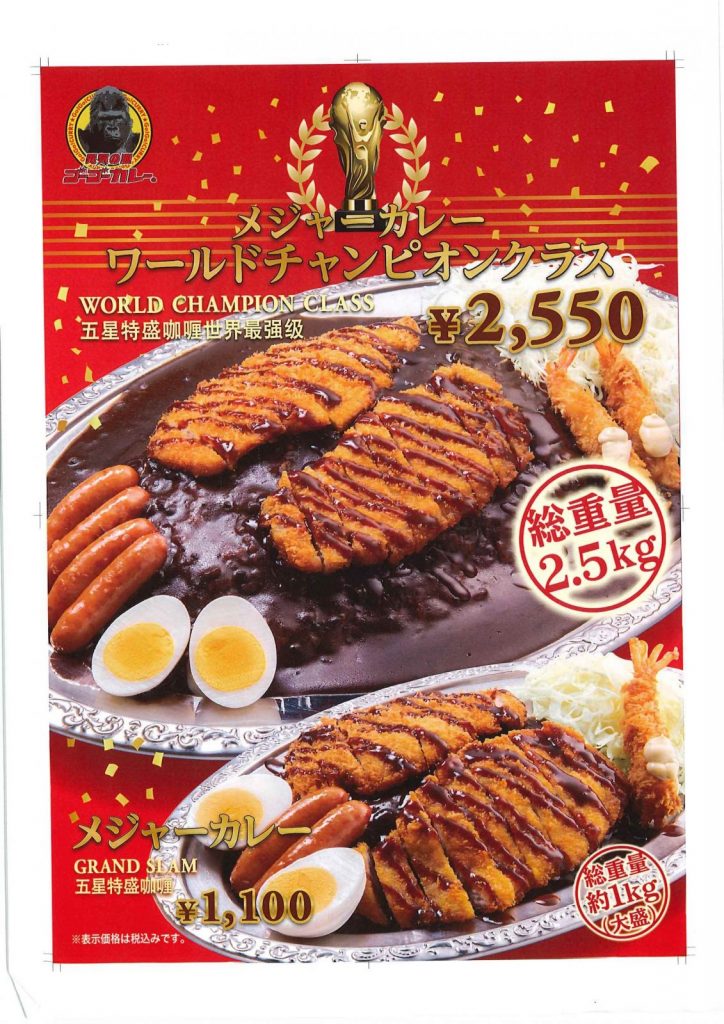
Go Go is funny in that they list the calories of each meal in terms of rice balls. And some are like 10 rice balls! They used to have a world champion curry, limited to a few orders per day per store [1]. 2.5kg!
Coco yichiban as a few stores in the LA area that are pretty on par with Japanese locations. I visited a branch in Beijing often when I lived in China (after eating there on a trip to Tokyo).
I tried Japanese curry for the first time in San Francisco a couple of weeks ago. Absolutely delicious.
I definitely noticed the English vibes. Actually, it reminded me a lot of Southern US homestyle food. Swap the rice for some potatoes and you could’ve fooled me.
I take issue with the common claim that 'curry' isn't a thing in a 'real' Indian restaurant. I did a quick survey online and could not find a single solitary Indian restaurant menu without curry on it. From the fanciest to the common takeout joint. There are even chains like 'Curry House'.
Let's tone down the virtue signaling in food reviews. It's silly. There are 150 languages in India; there are as many cuisines. To claim knowledge about the 'real Indian' food or culture is transparent nonsense.
On another slant, it's a rampant issue in YouTube videos where anybody with an Italian accent claim only they know how to make real Italian food. Learn a little history, folks.
The point is that “curry” is a British generalization.
Indian restaurants were historically called curry houses as a pejorative.
India has many dishes that one might consider a curry, but we have no dish called curry. The only use of the word curry in restaurants is to appeal to British nationals (and anyone they spread their culture to).
It’s an artifact of colonialism.
I also don’t understand why you think it’s virtue signalling. If anything, your appeal to “150 languages in India” is virtue signalling because you’re trying to make a benevolent justification for a word whose history you don’t understand. Also rich that you say “learn a little history folks” when you yourself clearly didn’t learn it in this instance.
Now, there is a word “Kari” in several South Indian languages but it’s used to mean spicy sauce or “kadipoda” which means spice mix, both derived from “black” in reference to the use of black peppercorns. The generalization into “curry” was one of colonial misinterpretation.
> The only use of the word curry in restaurants is to appeal to British nationals (and anyone they spread their culture to).
So, the Curry Points that dot Hyderabad are artefacts of British colonialism?
> The generalization into “curry” was one of colonial misinterpretation.
Yeah, no. The Telugu kura which is obviously cognate with kari is used to mean, well curry. How about you tone down the misinterpretation and false generalization?
Telugu Kari doesn’t mean curry in the sense that British people understand it. Please actually look up the history of what kari is.
The use of curry in Indian restaurants in Hyderabad are an artifact of colonialism. Hyderabad in particular caters a lot to foreign nationals due to the proliferation of the tech sector there.
Anyway What curry dishes are they serving there? “Hyderabadi chicken curry”? What is it called natively?
> Telugu Kari doesn’t mean curry in the sense that British people understand it.
As a native Telugu speaker, I use kura in the same sense as the English curry to refer to a diverse class of dishes.
> look up the history
Here's some history: Hyderabad was never colonized by the British. My grandparents who grew up in Hyderabad State and didn't speak any English used kura in the same sense that I do.
> Hyderabad in particular caters a lot to foreign nationals due to the proliferation of the tech sector there.
You don't have the faintest idea of what you're talking about. The Curry Points I mentioned are little hole-in-the-wall takeaway places that you see in every other street corner. They are almost exclusively patronised by Telugus. Forget foreigners, even migrants from other states usually find the spice levels too high.
> Anyway What curry dishes are they serving there? “Hyderabadi chicken curry”? What is it called natively?
Hyderabad existed as a politically and culturally separate entity. The ramifications of these historical distinctions play out in politics to this day. See Telangana statehood for an example.
> Kari in telugu
You keep bringing it up but to the best of my knowledge there's no kari in Telugu.
> The colloquial use of it as such is an artifact of British rule.
> Hyderabad existed as a politically and culturally separate entity
The only culturally separate population I know of on earth anymore are the Sentinelese on the Andaman and Nicobar islands.
Hyderabad's name itself is Arabic+Persian, and compared to India overall, far more people speak English there. It was a regional capital of South Asia. Cosmopolitan places like that are always cultural crossroads. Practically everyone/everyplace is a mutt, culturally and biologically, the world over, except perhaps the Sentinelese.
Sorry I meant Tamil Not Telugu. But the point remains the same. Curry in the British sense is not curry in any Indian sense. Kari doesnt imply a specific gravy dish, it implies a spiced sauce component. Saying you want a curry dish is like saying you want a cream dish when you order murgh makhani. It’s incongruent and a conflation of modern colloquial use vs the actual dish. Just like not ever meat dish is a ragu in Italy.
And Hyderabad may have been politically separate. It’s not culturally separate. Unless you purposefully deny any migration.
Hyderabad is not some unique snowflake among the Indian diaspora.
No because there’s no dish that’s a curry. It’s a component of a dish. Furthermore it’s a very specific component historically pepper based.
This is the problem. You borrowed a word that you don’t understand the depth of and are now arguing that it should be used in your way when people raise what it actually means. It’s a co-opting of a cultures word and cuisines.
There is no dish that’s “curry”. The British generalized it to be all spiced thick stews.
Would you call an eggs Benedict “a hollandaise”? Or roast potato’s as “chips”? No because there’s specifics to a dish that you afford it because you’re familiar with it. Calling them curries and expecting that to be the actual term is ignorance.
I'm not arguing it should be used in a particular way. On the contrary, I am specifically not insisting that the Telugu speaker and his grandparents' less specific use of kura is incorrect simply because it resembles the mostly more recent (and seldom pejorative, FWIW) use of its British English cognate.
"Chips" is an interesting example to bring up, because the word means completely different preparations of potatoes in different parts of the Anglosphere...
Kodi kura was the exact example that popped into my mind. Kura is a cognate/derivative from some Dravidian root similar to Kari/Curry (I believe Malayalam and Tamil use the kari form)
I assure you, if you ask for chicken curry in any restaurant in Hyderabad, they'll know exactly what you mean. They might not necessarily serve it though.
- curry is used in Britain (and any place they colonized) to refer to any and all spiced gravy, not just sauce.
- Kari in Tamil (widely considered to be the root of the word curry) refers to a dark, spiced sauce. It doesn’t mention it’s a gravy and it likely referred to a black peppercorn based sauce. It is simply an element of a dish like a bechamel. It is not a dish by itself.
- kodi kura is a specific preparation of chicken. Kura doesn’t mean curry, its closest English translation would be a stew. And even if it would be classified as a curry in England, it doesn’t change that it’s neither what they call curry or that other dishes that they call curry aren’t a form of kari in India.
Lastly, you take great pains to say that Hyderabad is culturally and politically independent from the British rule. So by that logic it wouldn’t even be a usable argument to say Curry is derived from those words
At the end of the day, the most well known etymology for curry is a mistranslation of the Tamil `Kari` where they mistook a single component of a dish to be the whole dish.
It was further perpetuated in the west as a stereotyped dish. Many Indians accept the word curry today because it was introduced into our zeitgeist but the concept of Curry as it is in the Uk has no foundation in actual Indian cuisine.
> Kura doesn’t mean curry, its closest English translation would be a stew
FFS, no! A dry stir fry is called a podi kura, with podi meaning dry. A stew like curry would be called a pulusu kura.
> Lastly, you take great pains to say that Hyderabad is culturally and politically independent from the British rule. So by that logic it wouldn’t even be a usable argument to say Curry is derived from those words.
Telugu speakers of Hyderabad State used the same word as their colinguists in the British ruled Madras Presidency. This would suggest the term predates the annexation of the Northern Circars by the British who could have then adopted it.
> At the end of the day, the most well known etymology for curry is a mistranslation of the Tamil `Kari` where they mistook a single component of a dish to be the whole dish.
At the end of the day, curry is a perfectly valid coinage and is cognate with kura and used to mean the exact same thing.
> It was further perpetuated in the west as a stereotyped dish. Many Indians accept the word curry today because it was introduced into our zeitgeist but the concept of Curry as it is in the Uk has no foundation in actual Indian cuisine.
Curry is quintessentially Indian. The fact that some Indian languages don't have an equivalent encompassing term doesn't change that.
> Now, there is a word “Kari” in several South Indian languages but it’s used to mean spicy sauce or “kadipoda” which means spice mix, both derived from “black” in reference to the use of black peppercorns.
Is this the same word as "kara", black, in Turkic languages?
Curry comes from the Tamil word (கறி kaṟi). The curry we have today is a mix of different influences - Ancient Indian (mustard, fennel, cumin, black pepper, curry leaves), Mughal, and Portuguese (Chilli pepper, tomato). There are subtle but important difference but they all share some similarities - especially the spices. Although curry powder (turmeric, coriander, fenugreek, cinnamon, cumin, black pepper, ginger, and cardamom) - those are every day spices in South India which was where most spices where exported from, historically. And we use that exact combination to this day.
I see it frequently in British cooking shows - trying to lay claim for curry. I'm sure curry has evolved like with any cuisine. But it's absolute bonkers that even James May seems to think that curry originated in Britain. Now, that's some fine poppycock.
I was making the claim that if you went to a restaurant in India, you wouldn't normally find any menu item called "curry", because curry is a genre of foods and not one single item in Indian cuisine.
This might be a language barrier issue, but I have never seen an Indian-style restaurant advertise a dish as "curry" in any country I've visited. Even in Japan (I live in Tokyo and have several インド料理 shops nearby), even if the shop itself has カレー in the name, the menu will say what each thing is (keema, sagh paneer, etc).
Imagine sitting down and opening a menu and seeing something labelled "soup" or "sandwich"!
North Indian dishes like da saag I keens might be evolving to care less to use it. But I’d bet that’s not just North Indian Christine. Restaurant opened by todays emigrating Indians are more aware of the choices than 30-50 years ago. It was a very different world.
It has roots in some Indian languages, but is not pervasive like it is today across all Indian cuisines.
Part of this is interesting to learn the stories of the early Indians who left India either as indentured servants which turned out to be an updated form of slavery, or emigrating as labourers from north India (and other areas) and how those migrations played out across the colonized world.
Supposedly curry comes from the tamil word (transliterated as) "kaRi" which may be related to black pepper (native to India) to spice things up. In all Indian languages the color black has a very similar name (in Gujarati Kāḷī (feminine) or kāḷo (masculine) etc. -- also the goddess Kāli -- the one who is black or death!). More generally associated with something burnt (blackened). Anyway, a spicy sauce would be kaRi. In restaurants in South India you may find various dishes named curry (such as kozhi curry or kozhi kari). But when most everything is spicy, why even say that? Indians would rather know what is in a recipe than how it tastes! [Lot of speculation here: perhaps some knowledgeable Tamil will correct this without getting all upset!]
I should also point out "curry leaves" -- not sure if there is a connection with curry. They are not spicy but are put in many Indian dishes to give them a certain flavor.
Thanks! In Gujarati we call it "meettho limdo" or sweet neem. It is dark green but not black (except when left in the 'frig for a few days or on the plant when it is sick!).
There’s some possible history further back in our languages where kala might have meant darker not just black.
Similarly the etymology of Krishna (the deity) is both considered “dark” or “black” depending on whom you ask.
I suspect it may be a case where our languages at the time didn’t need to delineate between black and a dark colour. Tone/shade was a relative unlike hue.
- Is it possible Indian restaurants like other cuisine were packaged for a non-Indian audience as much as an Indian audience?
- Too many people faint at the sight of having to read and pronounce an Indian name, how might it go with something that isn’t short like naan, cha? Even with naan (which means bread), bread is added on to hear people say bread bread. Cha/chai is tea, and Indians live to hear people say tea tea.
- In this way curry might be a common word added to dishes.
- Next time, at an Indian restaurant, see if you can over hear any Indian guests who exclude the word curry from their sentence when ordering.
- Maybe it’s worth asking Indian mothers if the word curry was used by them.
- The etymology of curry is readily available. At most it’s a style of cooking (like bbq).
- There’s actually over 500 languages in India, but they might have been all the same to the British, so let’s just call it all a curry.
The only dish I can think is kadhi which is made with cooked yogurt. It’s not spelled or pronounced like curry.
Well on the italian note calling 'curry' 'a thing' is like calling 'pasta sauce' 'a thing'. Like sure in a very vague sense but if you went into a restaurant and it had "Noodles with pasta sauce" as a dish it would (I hope) make you pause at least.
I mean there is no dish that is curry similar to how sandwich isn't a good. Sandwiches are a class of food with very disparate things being called sandwiches. Same with curries. The existence of sandwich shops does not mean there is a singular dish called sandwich
> Tempura (天ぷら or 天麩羅, tenpura, [tempɯɾa]) is a typical Japanese dish usually consisting of seafood, meat and vegetables that have been battered and deep fried. The dish was introduced by the Portuguese in Nagasaki through fritter-cooking techniques in the 16th century. The word tempura comes from the Latin word tempora, a term referring to times of fasting when the church dictated that Catholics go meatless.[1]
A lot of Japanese dishes that are popular today have foreign origins.
Tempura, curry, ramen, and salmon for sushi.
It’s why I find it hilarious when some people obsess over the authenticity of Japanese food and deride fusion cuisine.
It (much like most great cuisines) is the result of intermixing and interpretations of dishes.
Many Indian dishes too wouldn’t have existed without foreign interaction. Potato dishes obviously (which are very prevalent) but even things like Butter chicken or many Mughal based dishes.
The origin of food is in many ways just as as interesting as the etymology of words.
Salmon for sushi seems not to be the famous story that was going around. Like, it has all the tenets of a nice fake story, talking about Japan and how a foreign more familiar power outsmarted them, but apparently salmon was popular way before Norway theoretically started marketing it:
That video isn’t the refutation I think he thinks it is. I’m sure there’s more nuance than “Norway invented salmon sushi” but his argument is a little flakey imho.
His premise is based on American documents of sushi, but salmon was already a popular fish in the west by then. So it stands to reason that they’d use local fish for this dish that depends on good quality protein.
I’m not saying he’s necessarily wrong but his process of arriving at the result is weird, so I don’t think he’s necessarily right either.
Very many dishes in nearly every cuisine have at least some foreign origins. The majority of spices and seasonings used in most countries originate from many places all over the world.
The idea of any pure culture (locally, ethnically, linguistically, or culinarily) is a complete myth, unless that culture has been entirely isolated from every other culture for its entire development.
Southeast asian ingredients introduced via trading empires based in South India (i.e. nutmeg).
Tomatoes, chilies, potatoes, all pre-Columbian American products introduced to India by the Portuguese.
Tea (from China by way of the British)
Coffee (introduced even earlier than tea via the Arab trading networks via Yemen during the Ottoman empire).
Some things are actually bidirectional. Biryani, the Mughal/Persian rice dish emerged after rice was introduced to the middle east in ancient times, probably via India, and it came back in the form of Biryani.
One of my favorite Indian dishes is Poori Masala (eaten with Poori obviously), which is mostly potatoes & tomatoes, both of which come from the New World.
this is a beautiful story, thank you for writing it.
Curry is much like India - you believe in it, thats why it exists. And you will curry controversy no matter what you write ;)
also, in case you didnt know - Ras Behari Bose and Subhash Chandra Bose are the most mysterious of Indian freedom fighters. With the exact history unknown to this day. Ras Behari Bose created the INA and adopted the resolution that made Subhash Chandra Bose as the leader, while he was living in Japan.
Even today, the Indian parliament is rocked with demands that the "secret files" be opened. The Netaji papers were recently declassified - https://nationalarchives.nic.in/content/netaji-papers - but the papers are not complete.
I see your curry imported by British, and I raise you Spaghetti Naporitan[0], pasta with ketchup and american bacon invented by a Japanese who was inspired by US army rations.
Interesting to compare/contrast with how in the Philippines it's popular to eat spaghetti with ketchup (or a ketchup-y sweet tomato sauce) and chopped up hot dog
The bit about ubiquitous Nepali-owned restaurants makes me nostalgic for living in Japan. They may not be authentic but they are great for lunch. Typically, at lunchtime, 2 small curries, naan, salad and a soft drink bar is ¥800-¥1000. And it’s served instantly.
From experience of traveling to many countries and talking with people about food - not everyone is interested in it. I've heard many bad recommendations or people surprised I know the dishes they have never tried. And that's okay.
Ah, well, even in that case there's still a lot of things Indian people don't know about Indian food. Just by virtue of being Indian we do not learn everything there is to know about Indian people / food / culture.




- This is patently wrong. Curry is a South Indian word referring to vegetables originally (Malakkarry means vegetables). Come to Kerala - you have Moru Curry (Butter Milk Curry) , Erachi Curry (Beef Curry), Tharavu Curry (Duck Curry) etc. The author is a North Indian oblivious of curry history.
"കറി വെപ്പാനെന്തുള്ളത് കാട്ടിൽ, വിറകിന് മാത്രം മുട്ടില്ലിവിടെ"
[kari veppaanenthullathu kaattil, virakinu maathram muttillivide]
"What is there to make curry in the forest? Only firewood is available here" - Kiraatham Thullal by Kunchan Nambiar, Malayalam poet Circa 1750 AD.